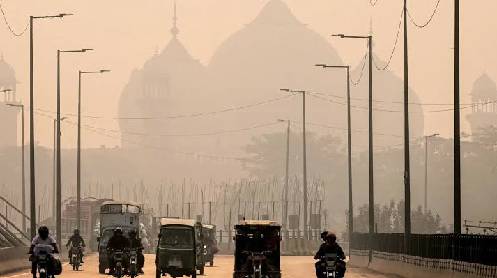
PARIS: Lahore has been ranked among cities with “extremely poor” ozone levels, according to a new analysis by the European Union’s Copernicus Atmosphere Monitoring Service (CAMS), highlighting the growing link between climate change, extreme heat and air pollution.
Thank you for reading this post, don't forget to subscribe!The analysis found that 34 per cent of the global population was exposed to “extremely poor” ozone air quality between January 1 and September 15, with ozone concentrations significantly exceeding World Health Organisation (WHO) exposure guidelines.
Ground-level ozone forms when heat and sunlight react with pollutants released by vehicles, industries, wildfires and other sources. At elevated concentrations, it can harm human health, ecosystems and agricultural yields. Ozone in the stratosphere, however, plays a vital role by protecting life from harmful ultraviolet radiation.
According to the report, record-breaking heatwaves and wildfires in Europe and North America contributed significantly to ozone pollution this year, while major fires in Indonesia and other parts of Southeast Asia also added to the problem.
“Air pollution does not stop at borders. It can travel thousands of kilometres, crossing continents and oceans and affecting air quality far from its source,” CAMS Director Laurence Rouil said.
CAMS monitors air pollution and wildfires using satellite observations and computer models.
The WHO recommends a maximum ozone exposure level of 100 micrograms per cubic metre, averaged over eight hours. The CAMS analysis found that another 17pc of the world’s population experienced “very poor” ozone air quality, while only 5pc was exposed to “good” levels.
Asia recorded the highest exposure, with 53pc of its population experiencing “extremely poor” ozone levels and another 22pc exposed to “very poor” conditions. Industrialisation, transport, economic activity, wildfires and agricultural-residue burning were identified among the major contributors.
New Delhi, Dhaka, China’s Chongqing and Pakistan’s Lahore were among the cities classified as having “extremely poor” ozone levels.
The report noted that while significant progress has been made in reducing several harmful air pollutants, ozone has proved more difficult to control because climate change is creating conditions that favour its formation.
In Europe, air pollution regulations have helped reduce emissions of several pollutants, although ozone remains a major challenge. Ozone pollution is associated with around 60,000 premature deaths annually in Europe, according to Ian Marnane of the European Environment Agency.
In North America, ozone levels remained relatively unchanged despite emissions-reduction policies, the report said.
Africa also faced significant air-pollution challenges, with smoke from wildfires, crop burning and cooking contributing to pollution, while Saharan dust can travel as far as Europe. About 8pc of Africa’s population experienced “extremely poor” ozone conditions this year.
South America recorded high ozone levels in cities including São Paulo and Rio de Janeiro, although 81pc of the continent’s population experienced “good” or “fair” ozone conditions.
Oceania recorded the most favourable conditions, with 66pc of its population experiencing “good” ozone levels and the remaining 34pc living under “fair” conditions.
By AFP